
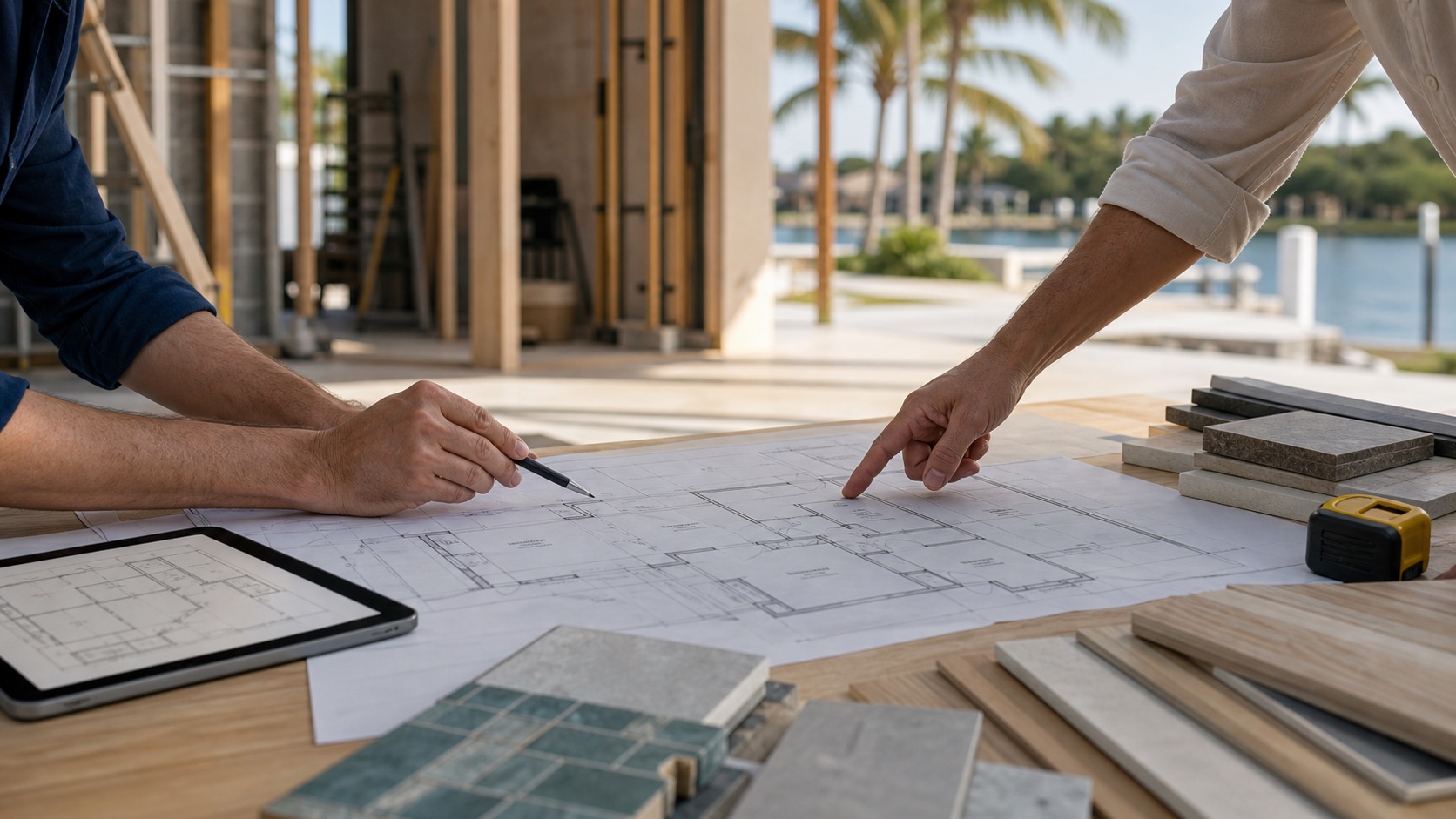
Design-Build vs. Hiring a Contractor and an Architect Separately
The difference between design-build and hiring an architect and a contractor separately is not really about drawings. It is about who is accountable when the drawings and the budget disagree - and on a renovation, they will disagree at some point.
Both models build good projects in Sarasota. They fail in different ways, and they suit different owners. Here is how each one actually works day to day, so you can pick the one that fits your project rather than the one your first phone call happened to be with.
How the Traditional Separate-Hire Model Works
You engage an architect or designer first. They develop the design, produce drawings, and take the project to a point where it can be bid. You then take those drawings to several contractors, collect bids, and select one. The architect may stay on to administer the contract during construction.
The defining feature is that design and construction are two separate contracts with two separate firms. Your architect works for you. Your contractor works for you. They do not work for each other.
The strength of this model is design independence. Your architect has no financial interest in how the project gets built, so their advice on design is uncompromised. For architecturally ambitious work, that independence is genuinely valuable.
The weakness shows up when the bids come back over budget. Redesign takes time and costs more in design fees, and the two firms can end up pointing at each other - the contractor says the design is unbuildable at that price, the architect says the pricing is inflated. You are the one in the middle, and you are the one paying for the delay.
How Design-Build Works
Design and construction sit under one contract with one firm. The team that will build the project is involved while it is still being designed, which means real construction pricing informs the design as it develops rather than arriving as a verdict at the end.
Day to day, this changes the shape of the process. Instead of design, then bid, then discover the budget problem, you get continuous costing. When you ask what it would take to open up the kitchen wall, you get a structural answer and a price in the same conversation.
The strength is accountability. One firm is responsible for the outcome, so there is no gap between what was drawn and what gets built for someone to fall through. The weakness is that you give up some independence - the firm advising on design is the firm that will price and build it, so you are relying more heavily on their integrity.
That is why transparency matters more in design-build than in any other delivery model. Line-itemed estimates and named allowances are not a nicety here. They are the mechanism that keeps the model honest.
Cost: An Honest Comparison
Design-build is often marketed as cheaper. That is not reliably true, and any firm that promises it is overselling.
What design-build does reliably do is reduce a specific category of cost: the redesign cycle. In the separate model, design work is done before anyone prices it. If the bids come back well over budget, the redesign is real time and real money. Design-build catches that mismatch earlier, when changing direction is cheap.
It also tends to reduce change orders originating from design gaps - details that were not fully resolved on paper and get discovered on site. Because the builder reviewed the design throughout, fewer of those gaps survive to construction.
Where the separate model can win on cost is competitive bidding. Taking a complete set of drawings to several contractors creates genuine price pressure. If your project is well-defined and you have time to run a proper bid process, that competition can save real money.
The honest summary: design-build usually costs less in avoided rework and provides more certainty earlier. Competitive bidding on complete drawings usually produces the sharpest single number. Which matters more depends on your project.
Timeline: Where the Difference Is Largest
This is where the two models diverge most clearly, and it is often the deciding factor.
The separate model is sequential. Design finishes, then bidding happens, then construction starts. The bidding phase alone is dead time - a period where you are paying for nothing to be built while contractors price the work and you evaluate proposals.
Design-build overlaps these phases. Long-lead items can be identified and ordered while design is still being finalised. Permitting can be prepared in parallel. In a market like Sarasota, where material lead times and permit timing both affect the schedule, that overlap is a real advantage.
If your project has a hard deadline - a rental you need turned before season, a move-in date, work you want completed before hurricane season - that overlap is usually the strongest argument for design-build.
When Hiring Separately Is Genuinely the Better Call
We would rather tell you this than win a project that was a poor fit.
- The design itself is the point. For architecturally ambitious work where the design is the primary value, an independent architect with no construction interest is worth the extra coordination.
- You already have drawings. If a complete set exists, the design phase is done. Take it to competitive bid.
- You have an architect you trust. An existing relationship with someone who knows your taste is worth a great deal.
- Your priority is the lowest possible number and you have time. A well-run bid on complete drawings creates price pressure design-build does not.
Conversely, design-build tends to fit renovations of existing homes - where conditions are uncertain until walls open - projects on a firm deadline, and owners who want a single point of accountability.
Questions That Reveal Which Model a Firm Really Runs
Plenty of firms describe themselves as design-build. Fewer operate that way. These questions surface the difference:
- Is the design fee separate from construction, and what happens to it if I do not proceed to build?
- At what point in design do I receive real construction pricing, not an estimate range?
- Who is my single point of contact from first meeting through final walkthrough?
- Is design in-house, or subcontracted to a firm you work with?
- How are changes priced once construction has started?
- Can I see a line-itemed estimate with named allowances rather than a lump sum?
How Design-Build Works at Full Spectrum
Full Spectrum Construction Group runs design-build across Sarasota and Southwest Florida. Nick Volkov founded the company in 2018; we hold Florida general contractor licensing and EPA Lead-Safe certification, and we have completed more than 10,000 projects.
Our process runs in five stages. We start with a walkthrough to understand goals, scope and constraints. We develop the design with construction pricing attached as it evolves, so you are never designing blind. You approve a line-itemed scope with named allowances for every finish category. We handle permits, scheduling, materials and trades. We finish with a punch list and a final walkthrough.
One point of contact throughout. Changes priced and approved in writing before anyone starts work. You can see the range of what we self-perform across our services, read more about whole-home projects on our renovation page, and see new-build work on our custom homes page. For projects specifically in the area, our Sarasota page covers the neighbourhoods we work in most.
Deciding for Your Project
If your project is design-led, you already have drawings, or you have the time to run a competitive bid, hiring separately is a sound choice and we will say so.
If you are renovating an existing home, working to a deadline, or you want one firm accountable end to end, design-build will likely serve you better. Either way, ask for a line-itemed estimate with real allowances - that single document tells you more about how a firm operates than any label on their website.
Book a walkthrough and we will talk through which model suits your project honestly, including when that answer is not us.
Frequently Asked Questions
Is design-build cheaper than hiring an architect and contractor separately?
Not automatically. Design-build reliably reduces redesign cycles and change orders caused by design gaps, which is where a lot of hidden cost lives. But competitive bidding on a complete set of drawings often produces the sharpest single price. Design-build usually wins on certainty and schedule rather than on headline cost.
Do I still need an architect with design-build?
It depends on scope. Many renovations do not require stamped architectural drawings, and design is handled within the design-build team. Structural changes or new construction may require a licensed architect or engineer, which the design-build firm coordinates as part of the process.
Which model is faster?
Design-build, in most cases. The separate model is sequential - design, then bid, then build - and the bidding phase is time where nothing is being constructed. Design-build overlaps design, permitting and procurement, which matters in Sarasota where material lead times and permit timing both affect the schedule.
How do I keep a design-build firm honest on pricing?
Insist on a line-itemed estimate with a specific dollar allowance for every finish category, and a written change-order process that prices and approves changes before work happens. A firm unwilling to provide either is not running transparent design-build regardless of what they call it.
Can I switch to a different contractor after the design phase?
That depends on your contract. Some design-build agreements separate the design fee so the drawings remain usable if you decide not to proceed to construction. Ask this before you sign, and get the answer in writing.